Live vs Automated Tables, Teen Patti
A practical guide to live vs automated tables for teen patti: the steps, the limits and the common mistakes.
What is Live vs Automated Tables?
When you sit down to play teen patti online, you will quickly discover that not all tables are built the same way. The two dominant formats available across every major platform are live dealer tables and automated (RNG) tables, and understanding the difference between them is one of the most important decisions you can make as a player.
A live teen patti table connects you in real time to a human dealer who is physically present in a professionally equipped studio. Cards are shuffled and dealt by hand, the action unfolds on a high-definition video stream, and the outcome of every round is determined by the dealer's physical movements, not by a computer algorithm. You interact through an on-screen interface, place bets on a digital felt overlay, and watch the cards land in real time, often alongside other players at the same virtual table.
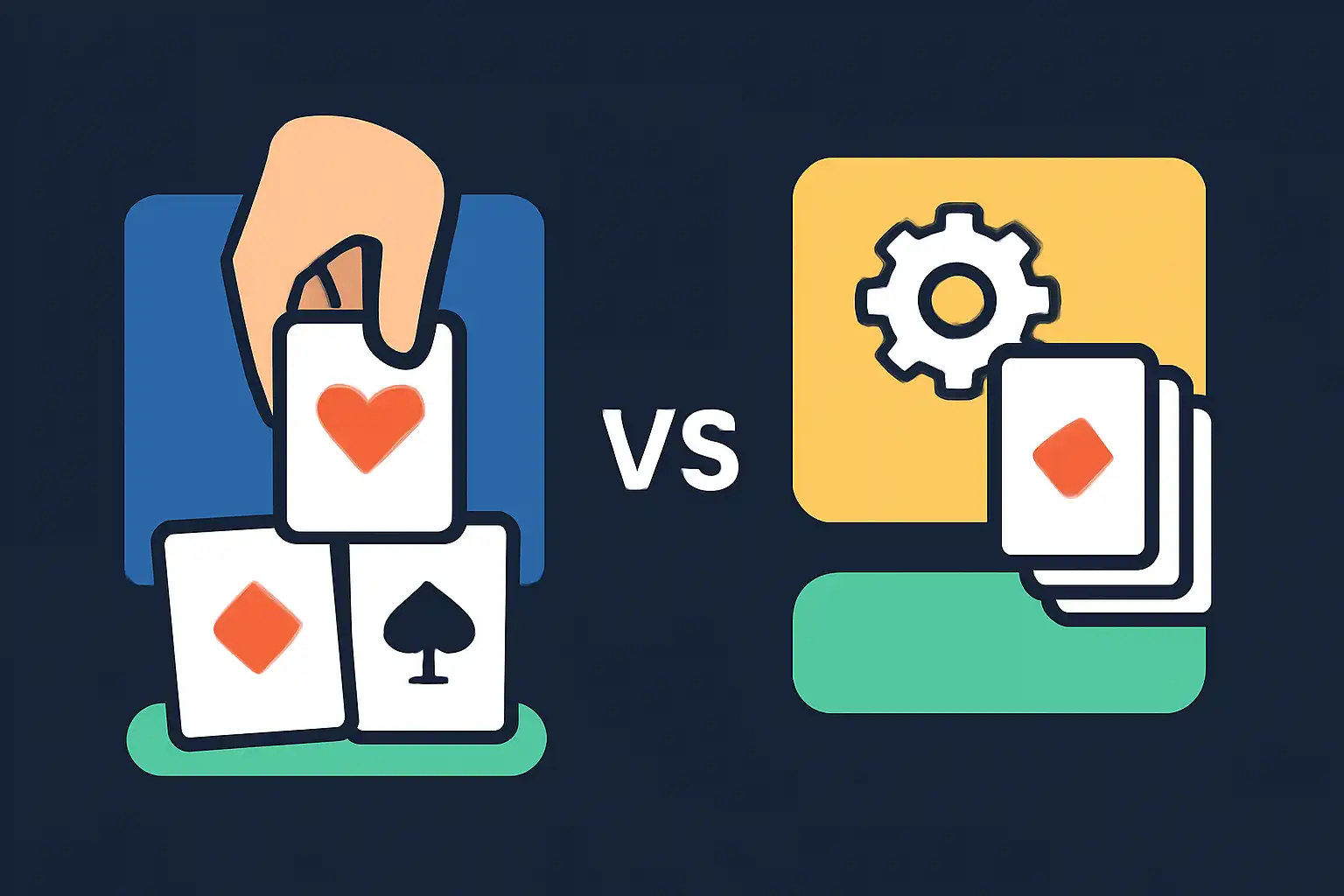
An automated teen patti table: also called an RNG (Random Number Generator) table, removes the human dealer entirely. A certified software engine simulates the shuffle and deal instantaneously, and results are produced by a cryptographically secure algorithm that has been independently audited. These tables are available 24 hours a day, run at whatever pace you choose, and allow you to play solo without waiting for other participants. Both formats deliver the authentic teen patti experience, three-card hands, the classic boot, Chaal and Pack decisions, but through very different mechanisms.
Live vs Automated Tables safety, fees, and timing
Automated tables rely on RNG software tested and certified by independent laboratories such as eCOGRA, iTech Labs, or GLI. These auditors verify that no outcome can be predicted or exploited and that the published RTP is mathematically accurate. Live tables introduce a different trust model: a human dealer handles physical cards in a studio monitored by multiple cameras, floor supervisors, and compliance officers. Seeing real cards dealt in real time is, for many Indian players, the highest form of reassurance available online.
On the cost side, live tables typically carry higher minimum boot amounts, often ₹50 to ₹500, to offset studio infrastructure and dealer salaries. Automated tables can start as low as ₹1 to ₹10, making them far more accessible for players managing a tight bankroll or testing a new platform. Side bets offered exclusively on live tables (Pair or Better, Lucky 6) carry a higher house edge than the main game, so playing them repeatedly erodes your balance faster than the base game alone.

Timing is where the two formats diverge most sharply. An automated session can process 200 to 400 hands per hour at a brisk pace, while a live dealer table typically delivers 40 to 80 hands per hour. Faster play means your bankroll faces the house edge far more frequently in automated games, a factor budget-conscious players must weigh. Live tables build in natural pauses between hands that many players find helpful for discipline. Automated tables are available around the clock with zero wait time; live studios may reduce their teen patti roster in the early morning hours, with peak availability running roughly 7 PM to 1 AM IST.
How Live vs Automated Tables works
In a live teen patti game, multiple high-definition cameras capture every angle of the dealer and the card shoe. Optical Character Recognition (OCR) technology reads the physical cards the moment they are placed face-up and feeds that data into the game software, which then updates every connected player's screen simultaneously. The result is a seamless experience where you see a real card deal but interact through a polished digital interface, placing bets, selecting Chaal or Pack, and viewing your hand value all within the same screen.
Automated tables work through a server-side RNG engine that generates a fresh, verified random seed for every hand. The moment you click "Deal," the software draws three cards from a virtually shuffled 52-card deck and renders them as animated graphics on your screen. No dealer is required, no stream needs to buffer, and no other player's decision affects the speed of your round. The entire cycle, boot, deal, decision, outcome, can complete in under ten seconds if you play quickly.

What to look for when comparing the two formats:
- Stream quality: Live tables require a stable connection of at least 5 Mbps for smooth HD video. Automated tables function reliably on 1 Mbps or even slower mobile data.
- Game variants: Live studios on leading platforms offer Classic Teen Patti, One-Day Teen Patti, and Joker variants with dedicated tables. Automated lobbies may offer a wider range of lower-stakes novelty variants.
- Dealer interaction: Live tables allow text chat with the dealer, adding a social layer absent from automated play.
- Bet limits: Live tables often extend to higher maximums, ₹25,000 or above per hand, catering to high-stakes players who want ceiling room unavailable on most automated tables.
Common Live vs Automated Tables questions
Are live tables rigged compared to automated tables? No. Both formats at licensed platforms are subject to independent audits. Live studios use multiple cameras and pit managers to prevent manipulation, while automated tables carry RNG certificates that are publicly verifiable. The house edge is built into the game rules in both cases and is not altered between the two formats when the rules are identical.
Can I use UPI apps like PhonePe, GPay, or BHIM to fund both table types? Yes. Deposits made via PhonePe, Google Pay, or BHIM UPI are credited to your general platform wallet and can be used at any table, live or automated, without restriction. Withdrawals back to a linked UPI ID are typically processed within 30 minutes to 4 hours regardless of which table type generated the winnings.
Do bonuses apply to live teen patti tables? This varies by platform. Many operators restrict welcome bonuses and reload offers to automated (RNG) table play, because live dealer games contribute at a lower rate, often 10% to 20%, toward wagering requirements. Always read the bonus terms before selecting a table type when playing with promotional credit. If you are on a bonus, automated tables will clear the wagering requirement significantly faster.

Is the RTP different between live and automated teen patti? When the game rules are identical, the theoretical RTP is the same. Differences arise only when live tables include side bets or rule variations not found in the automated version, which can shift the house edge by 1% to 4% depending on the bet selected.